PDRN vs. Peptides: What’s Actually Different (and Which One Your Skin Needs)
| Quick Answer: PDRN is a DNA-derived molecule best known from professional, in-clinic injectable treatments that trigger deep tissue repair — though lower-concentration topical versions now show up in masks and creams too. Peptides are amino acid chains found in everyday serums and moisturizers that signal your skin to produce more collagen. If you’re building an at-home routine, peptides (and topical PDRN products) are accessible options. |
Although both are often grouped under “regenerative skincare,” they belong to very different categories—and that’s where most of the confusion starts. Let’s untangle it properly.
| Feature | PDRN | Peptides |
| Available at home | Limited (topical products exist) | Yes |
| Professional treatments | Yes | No |
| Main role | Tissue repair and regeneration | Cell signaling and collagen support |
| Daily use | Usually not | Yes |
| Best suited for | Post-procedure recovery | Fine lines, firmness, barrier support |
I have actually started incorporating topical PDRN, specifically the Medicube PDRN serum, Anua PDRN Hyaluronic Acid Capsule 100 Serum and Anua PDRN Hyaluronic Acid Capsule 100 Serum Mask, into my evenings lately, alongside the gentle, barrier-first basics. It’s a genuinely different thing from the in-clinic version — lower concentration, applied topically instead of injected.
What Is PDRN, Really?
PDRN stands for polydeoxyribonucleotide. It’s a DNA-derived compound most commonly purified from salmon or trout milt. Historically it’s been used almost exclusively in professional, in-clinic settings: think injectable treatments, post-procedure recovery protocols, or in-office skin boosters. That’s changed recently — brands like Medicube, Anua now sell topical PDRN serums, creams and masks, which is what I’ve been trying myself. It’s worth being clear, though, that these topical, lower-concentration formulas work differently from injectable PDRN.
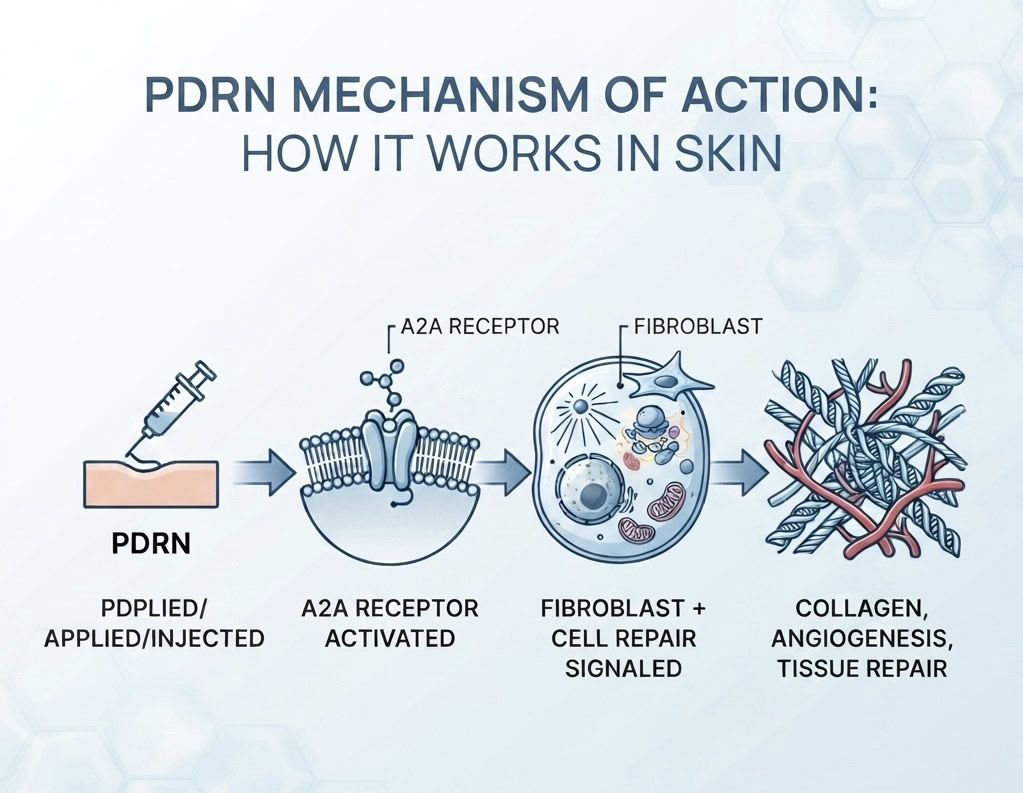
What makes PDRN interesting is how it works at a cellular level. It activates a specific receptor on skin cells — the adenosine A2A receptor, for the science-curious — which essentially flips on your skin’s own repair machinery. A comprehensive review published on PMC covering PDRN’s role in wound healing found consistently positive results across healing time, tissue regeneration, and cell migration.
The simplified version of how that plays out in skin looks something like this:
In practice, PDRN is used for things like:
A broader 2025 review of PDRN’s clinical applications and safety profilereported that across multiple studies, adverse effects were largely limited to mild, transient reactions like localized itching at the injection site — with one trial of over 200 patients showing meaningfully better wound closure versus placebo. That’s a genuinely strong safety signal.
Topical PDRN products, by contrast, are formulated as regular cosmetics — the kind of thing you can reasonably try at home, the same way you’d introduce any new active
Topical PDRN vs. Injectable PDRN
Although topical PDRN serums have become increasingly popular in Korean skincare, most of the strongest clinical evidence still comes from injectable medical applications. A serum and an injectable treatment should not be expected to deliver the same results because formulation, concentration, and delivery into the skin are fundamentally different.
What Are Peptides?
Peptides are short chains of amino acids — the same building blocks your skin uses to make collagen and elastin. Unlike PDRN, peptides are everywhere in skincare: serums, moisturizers, eye creams. You’ve almost certainly used a product with peptides in it, whether or not the label made a big deal of it. The American Academy of Dermatology includes peptides among its recommended anti-aging ingredients, alongside more familiar names like retinoids.
Not all peptides do the same job, though — and this is where a lot of product marketing gets vague. Dermatology research generally groups cosmetic peptides into four functional categories, each targeting a different part of the aging process:
| Type | What it does | Common examples | Best for |
| Signal peptides | Tell fibroblasts to produce more collagen and elastin | Matrixyl (Palmitoyl Pentapeptide-4), Matrixyl 3000 | Firmness, fine lines |
| Carrier peptides | Deliver trace elements like copper into the skin to support repair | Copper Tripeptide-1 (GHK-Cu) | Elasticity, healing support |
| Neurotransmitter-inhibiting peptides | Soften the look of expression lines by limiting muscle-triggering signals | Argireline (Acetyl Hexapeptide-8) | Dynamic wrinkles (forehead, eye area) |
| Enzyme-inhibitor peptides | Slow the enzymes that break down existing collagen | Soybean peptide, rice peptides | Preventing further collagen loss |
Copper peptides in particular have solid research behind them — Cleveland Clinic notes copper peptide is among the more well-studied types for improving skin’s appearance, with evidence pointing to support for collagen and elastin production.
The honest version: peptides are a gentle, cumulative ingredient. They’re not going to transform your skin overnight, and results build over weeks of consistent use. If you want to build a steady routine yourself, you can read more about my consistent skincare routine here.
Where Peptides Fit Into a Barrier-First Routine
Because peptides work at the signaling level rather than disrupting the skin barrier, they tend to layer well.
If PDRN and peptides have you thinking about collagen support more broadly, it’s worth mentioning LED light therapy here too, since it works through a completely different mechanism but toward a similar goal. Research published in the Journal of the American Academy of Dermatology found that low-level red and infrared LED light increased collagen, elastin, and hyaluronic acid production in human skin cells, and Cleveland Clinic notes it’s generally considered a safe, noninvasive option for supporting skin repair and reducing fine lines. Unlike PDRN, it’s something you genuinely can do at home with the right device — and unlike peptides, it works through light exposure rather than topical ingredients, which makes it a nice complement rather than a competitor to either.
Stress and Your Skin Barrier
Here’s something that rarely comes up in ingredient-focused articles like this one: no active ingredient, however well-studied, fully compensates for a stressed-out barrier. A narrative review on stress-induced skin changes describes how psychological stress activates the body’s cortisol response, which directly disrupts skin barrier lipids and structural proteins, leading to slower barrier recovery and higher water loss. That’s part of why I keep coming back to inner balance as a genuine skincare topic, not just a wellness buzzword.
PDRN vs. Peptides: The Real Differences
| PDRN | Peptides | |
| What it is | A DNA-derived molecule, typically sourced from salmon or trout milt | Short chains of amino acids, usually lab-synthesized |
| How it works | Activates adenosine A2A receptors to trigger tissue repair and regeneration | Signals skin cells to perform specific tasks, like producing more collagen |
| Where you’d use it | In-clinic injections (deepest effect) or topical masks/creams with lower-concentration PDRN | Serums and moisturizers you apply at home |
| Best known for | Wound healing, post-procedure recovery, deeper tissue repair | Firmness, fine lines, barrier support |
| Who administers it | Injections: a licensed provider. Topical: you, at home | You, as part of your daily routine |
The way I’d put it simply: PDRN repairs, peptides instruct. PDRN gives damaged skin the raw materials and signals to rebuild itself from a deeper level. Peptides work at the surface, nudging your skin’s existing processes to run a little more efficiently.
How They Work

Which One Is Right for You?
Here’s how I’d think about it, if someone asked me over coffee:
● If you’re building or maintaining a home routine — peptides are the reliable staple, and topical PDRN (like the Medicube and Anua products I’ve been using) is a reasonable addition if you want to try it. They layer easily with the barrier-repair basics I always come back to.
● If you’re recovering from a procedure, or want the deepest regenerative effect — injectable PDRN, discussed with a dermatologist, is the option for that level of repair. It’s not a replacement for your daily routine; it’s a different category entirely.
● If your skin is generally healthy and you just want firmer, more resilient-looking skin over time — start with peptides and consistency. That’s genuinely most of what moves the needle for most people.
| Your goal | Better choice |
| Home skincare | Peptides |
| Sensitive skin | Peptides |
| Daily collagen support | Peptides |
| Post-laser recovery | PDRN (professional) |
| Scar treatment | PDRN (professional) |
| Needle-free routine | Peptides |
They’re also not mutually exclusive. Some clinics do combine PDRN treatments with peptide-based home care afterward — deep repair in-office, ongoing support at home.
Why the Research Gap Matters
It’s worth being upfront about something most “regenerative skincare” content glosses over: PDRN and peptides sit at very different points on the evidence spectrum. Peptides have decades of formulation history and a large body of in-vitro and topical-use data, even if individual peptide types vary widely in how well-studied they are. PDRN’s strongest evidence comes from wound healing and orthopedic research, including randomized controlled trials for conditions like knee osteoarthritis, where safety and efficacy have been tracked closely. Its use in aesthetic medicine specifically is newer and growing fast, but a lot of that growth is ahead of large-scale aesthetic trials — which is exactly why “ask your dermatologist, don’t self-treat” isn’t just a disclaimer, it’s the actual right approach here.
Frequently Asked Questions
Is PDRN safe?
For injectable PDRN, published research generally reports a positive safety profile, with most adverse effects limited to mild, transient reactions like injection-site itching. That said, most studies note a lack of large randomized trials specifically in aesthetic (non-medical) settings — the strongest data comes from wound care and orthopedic use, so this is still a question for a licensed provider before trying it. Topical PDRN products, like the masks and creams I’ve used, are formulated and regulated as standard cosmetics, so the usual patch-test-first approach applies rather than a medical consultation.
Can I use peptides every day?
Yes — peptides are generally well-tolerated for daily use and pair easily with barrier-supporting ingredients. As always, patch test anything new and introduce one product at a time. If your skin barrier is currently compromised, read my complete Skin Barrier Guide before introducing any new active ingredients.
Can I use PDRN after exfoliating?
If you mean a mild at-home exfoliant and your skin feels completely comfortable afterward, a gentle topical PDRN product may be fine. But if your skin is red, stinging, unusually dry, or sensitized, I’d skip additional actives and focus on basic hydration and barrier support instead. Professional peels, lasers, microneedling, and other procedures are a different situation. Don’t assume that a product marketed as “regenerative” or “repairing” is automatically appropriate immediately after a procedure — use only what your provider recommends while your skin heals.
Can I use PDRN with vitamin C?
There isn’t a well-established reason that topical PDRN and vitamin C can’t be part of the same skincare routine. If your skin tolerates both, you could use them together, or simply separate them — vitamin C in the morning and PDRN in the evening is an easy routine. As always, the complete formula matters more than the name of one ingredient on the bottle.
Can I use PDRN and peptides in the same routine?
Yes, topical PDRN and peptide skincare can generally sit within the same routine, and there’s no obvious need to choose one and completely avoid the other. They’re used for different purposes, so I think of them as potentially complementary rather than competing ingredients.
Should I use topical PDRN in the morning or at night?
This depends on the individual product and its instructions. Many topical PDRN formulas can fit into either a morning or evening routine. I personally like using mine in the evening, when I tend to keep my routine more focused on hydration and barrier support.
Regardless of when you use it, sunscreen still belongs in your morning routine.
How often can I use topical PDRN?
This is one place where it’s important not to confuse topical PDRN with injectable treatments. Many cosmetic PDRN serums and creams are formulated for regular — sometimes daily — use, depending on the specific product. Start according to the manufacturer’s directions, introduce one new product at a time, and adjust based on how your skin responds.
Can sensitive skin use topical PDRN?
Potentially, yes, but “PDRN” on the ingredient list doesn’t automatically make the entire formula suitable for sensitive skin. Fragrance, exfoliating ingredients, botanical extracts, or other actives in the same product may matter just as much. If your skin is reactive, patch testing and introducing the product gradually is the approach I’d take.
Is topical PDRN suitable during pregnancy or breastfeeding?
There isn’t enough good-quality safety data on topical PDRN specifically during pregnancy or breastfeeding for me to make a blanket recommendation. If you’re pregnant or breastfeeding, I’d check the individual formula with your doctor or dermatologist rather than assuming that a product is appropriate simply because it’s sold as a cosmetic.
Can peptides and PDRN be used together?
In some clinical settings, yes — PDRN handles deeper repair in-office, while peptide-based home care supports skin between or after treatments. This isn’t something to combine on your own; it’s a protocol a provider would design.
Which peptide type should I look for first?
If you’re new to peptides, a signal peptide (like Matrixyl) or a copper peptide is a reasonable, well-studied starting point for general firmness and collagen support. Save neurotransmitter-inhibiting peptides for when fine lines from expression are your main concern.
Key Takeaway
If you’re choosing between PDRN and peptides, you’re probably not choosing between two skincare ingredients—you’re choosing between professional treatment and everyday skincare. For most people building a consistent routine at home, peptides are the more practical place to start, while PDRN is best discussed with a qualified dermatologist when professional skin repair is the goal.
Let’s talk about it 👇
I’d Love to Hear From You
Have you tried PDRN, peptides — or both?
I’d genuinely love to know what you’re using, how you’ve worked it into your routine, and what you’ve noticed from it so far. Leave a comment below and let’s help each other build healthier seasonal skincare routines.
This article may also contain affiliate links. I only recommend products that I personally use, trust, or believe may provide value to my readers