Why Sunscreen Became the Most Important Step in My Routine
Do I really need sunscreen every day?
For years, I thought sunscreen was something you used for beach days, holidays, or long afternoons outside. What I eventually learned is that daily sun exposure adds up quietly over time. A few minutes here. A walk there. Sitting near a window. Driving. Running errands.
Daily sunscreen is less about one day of protection and more about protecting your skin consistently over the years.
Quick Sunscreen Guide by Situation
| Situation | Recommended SPF | Reapply? |
| Everyday office work | SPF 30–50 | Usually not if indoors all day |
| Walking outdoors | SPF 50 | Every 2 hours |
| Retinol users | SPF 50 | Yes |
| Beach or hiking | Water-resistant SPF 50 | Every 2 hours + after swimming |
| Sensitive skin | Mineral SPF 50 | As needed |
Everything a gentle skincare routine helps improve — calmer skin, smoother texture, better barrier health, more even tone — stays vulnerable without daily SPF protection during the day. That was the moment sunscreen stopped feeling optional and became the most important step in my routine.
If your skin still feels reactive, uneven, or easily irritated despite using good skincare products, sunscreen may be the missing step in your routine.
Why Sunscreen Matters More Than Most People Think
Daily sunscreen use is one of the most important habits for long-term skin health — especially if your skin is sensitive, reactive, or exposed to active ingredients like retinol.
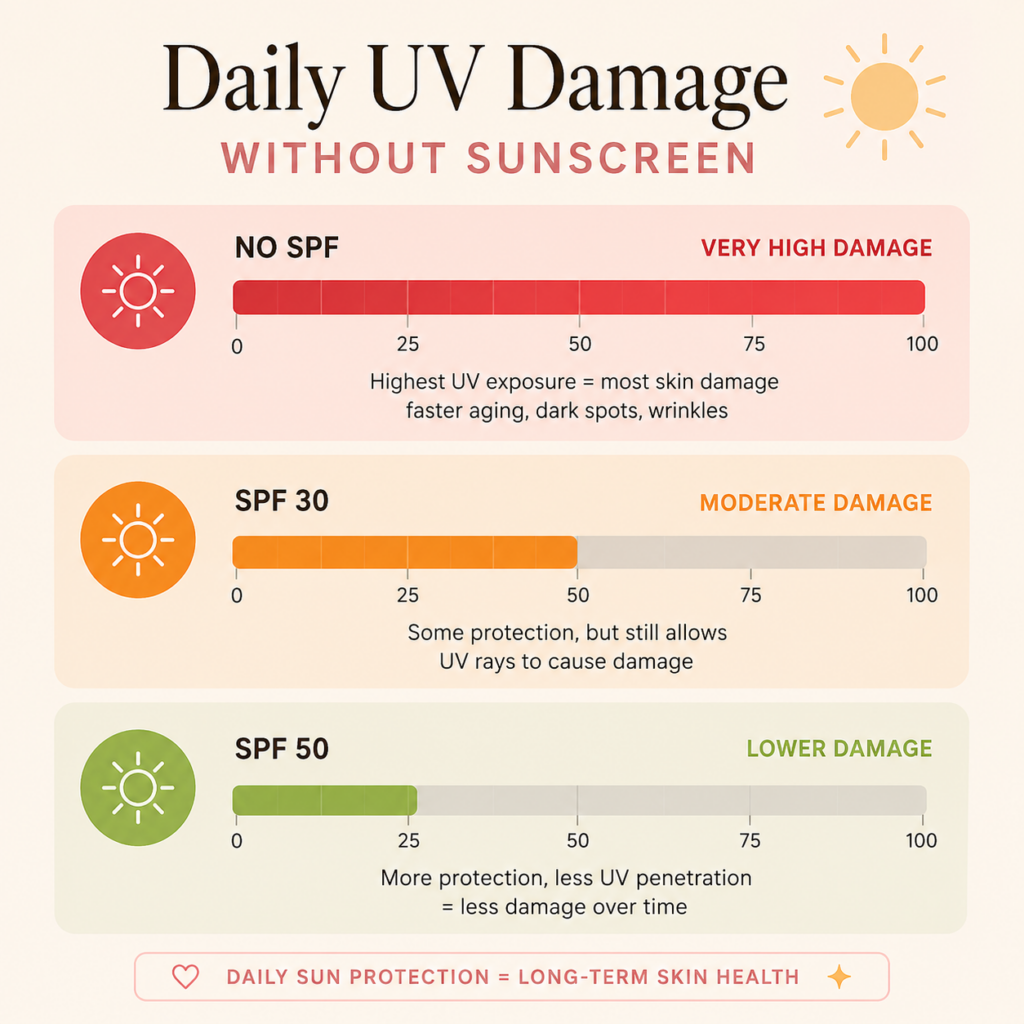
Here’s a simple visual comparison of how sunscreen helps reduce cumulative daily UV damage.
Who Benefits Most From Daily Sunscreen?
Daily SPF is especially important if you:
- use retinol
- exfoliate regularly
- have rosacea
- have melasma
- have sensitive skin
- spend time near windows
- use vitamin C
What happens if you don’t wear sunscreen every day?
Daily UV exposure accumulates over time. Without consistent sunscreen use, skin is more likely to develop uneven tone, hyperpigmentation, collagen loss, and increased sensitivity. The effects are often gradual, which is why many people don’t notice them until years later.
Most people think sunscreen is mainly about preventing sunburn. But daily SPF also helps protect your skin from the slow cumulative UV damage that gradually shows up as uneven tone, dullness, collagen breakdown, hyperpigmentation, and faster visible aging over time.
Clinical research consistently shows that daily sunscreen use helps protect skin structure and reduce long-term environmental damage.
Daily sunscreen use helps:
• Protect collagen structure from UV-induced breakdown
• Reduce and prevent uneven skin tone and hyperpigmentation
• Support barrier recovery by reducing daily environmental stress
• Maintain the results you are building with the rest of your routine
• Slow the visible effects of long-term sun exposure
Without it, even the most gentle and consistent skincare routine loses its effect over time.
Why Sunscreen Becomes Essential When You Use Retinol or Active Ingredients
If you use retinol or other active ingredients, sunscreen becomes even more important. The Skin Cancer Foundation specifically names retinol among the most common ingredients that increase sun sensitivity, alongside AHAs and hydroquinone — making daily SPF a non-negotiable pairing rather than an optional add-on.
Retinol increases your skin’s sensitivity to UV exposure because it accelerates skin cell turnover, leaving newer and more vulnerable skin cells closer to the surface.
Without sunscreen, your skin barrier often becomes more reactive, irritated, and slower to recover — even from everyday daylight exposure near windows or during cloudy weather.
Retinol works best when your skin is consistently protected during the day.
Sunscreen is not optional when using retinol. It is part of the routine itself.
Common Sunscreen Mistakes
- Applying too little sunscreen
- Forgetting the ears and neck
- Only wearing SPF in summer
- Not reapplying outdoors
- Relying only on SPF in makeup
How to Build a Consistent Daily Sunscreen Routine
Daily SPF Checklist
✅ Cleanser
✅ Moisturizer
✅ SPF 50
✅ Reapply outdoors
✅ Cleanse thoroughly at night
Is SPF 50 better than SPF 30?
Both provide excellent protection when applied correctly. However, SPF 50 offers a slightly higher level of UVB protection.
The easiest sunscreen routine to maintain is usually the simplest one:
Morning:
• apply sunscreen as the final skincare step, after moisturizer and before makeup
• use broad-spectrum SPF 50 daily
• apply enough amount for full protection — not just a thin layer
During the day:
• reapply every 2–3 hours when exposed to light (especially important if you’re outside)
• if you wear makeup, SPF mists or SPF cushions usually make reapplication much easier
Healthy sunscreen habits usually come from consistency, not perfection. No overthinking — just repetition.
How much sunscreen should I actually apply?
| Area | Recommended Amount |
| Face | Two-finger rule |
| Face + neck | About 1/4 teaspoon |
| Whole body | Around 30 ml |
Most people apply significantly less sunscreen than the amount used during SPF testing. Dermatologists confirm this gap is real: the AAD notes that most adults need about a full ounce — roughly a shot glass’s worth — to properly cover exposed skin, and recommend reapplying every two hours when outdoors.
A generous application is one of the easiest ways to improve the protection you receive from your sunscreen.
The sunscreen I personally use in my routine →
The sunscreen I personally use works well for my skin, but everyone’s skin is different. If you’re still looking for the right fit, explore my guide to the 7 best mineral sunscreens for sensitive skin in 2026, where you’ll find recommendations for acne-prone, dry, reactive, and combination skin types.
How to Reapply Sunscreen Over Makeup
If you wear makeup daily, sunscreen reapplication can feel confusing at first — but it becomes much easier once you find a format that fits naturally into your routine.
Sunscreen should always go underneath makeup, and the SPF inside most foundations is usually not enough on its own because the coverage is too thin and uneven.
Is the SPF in makeup enough?
Usually not.
Most people don’t apply enough foundation or tinted moisturizer to achieve the SPF level listed on the packaging.
Dedicated sunscreen should remain your primary source of protection.
For reapplication during the day, SPF mists or pressed SPF powders are often the easiest options because they maintain meaningful protection without disrupting makeup completely.
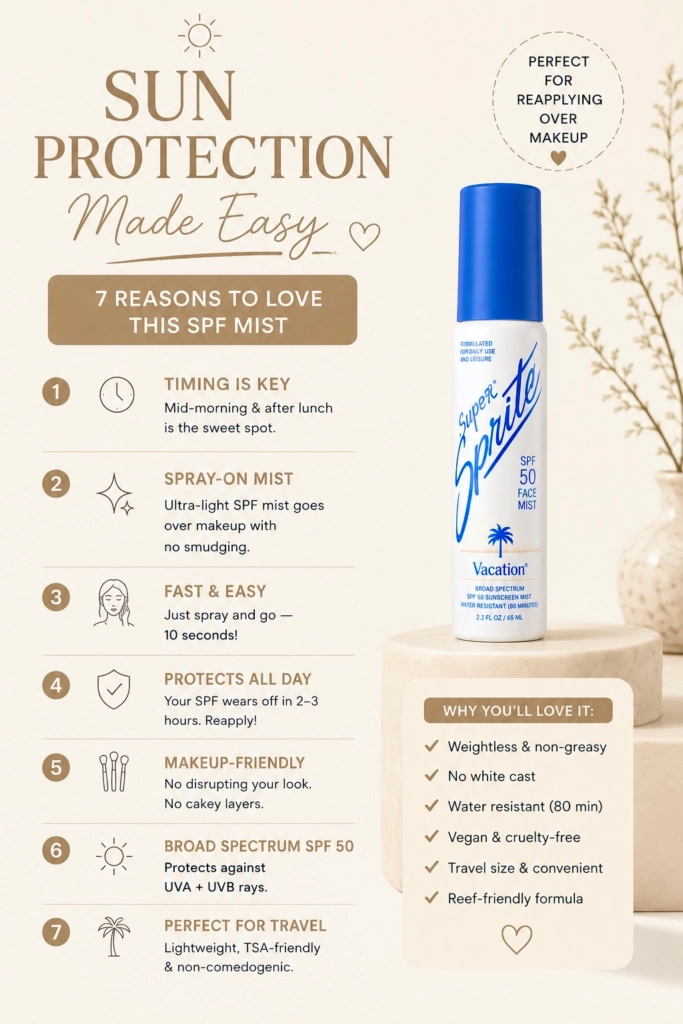
The sunscreen mist I personally use in my routine →
Can sunscreen help support your skin barrier?
UV exposure places ongoing stress on the skin barrier. Daily sunscreen helps reduce that stress, allowing your skin to focus on repair, hydration, and recovery instead of constantly defending itself from UV damage.
Why Sunscreen Works Best With a Calm Skincare Routine
Sunscreen works best when the rest of your skincare routine also supports your skin barrier consistently.
If your routine constantly irritates or overwhelms your skin, even good SPF habits become harder to maintain consistently. During summer, this becomes even more important because heat, sweat, and increased UV exposure can easily overwhelm the skin barrier.
These simple summer skincare habits helped me keep my skin healthy, and naturally glowy even during hotter months.
Combined with a calm skincare routine, sunscreen helps support::
• barrier repair (like ectoin-based routines)
• calming habits
• consistent skincare rhythm
Why ectoin became my favorite barrier support ingredient →
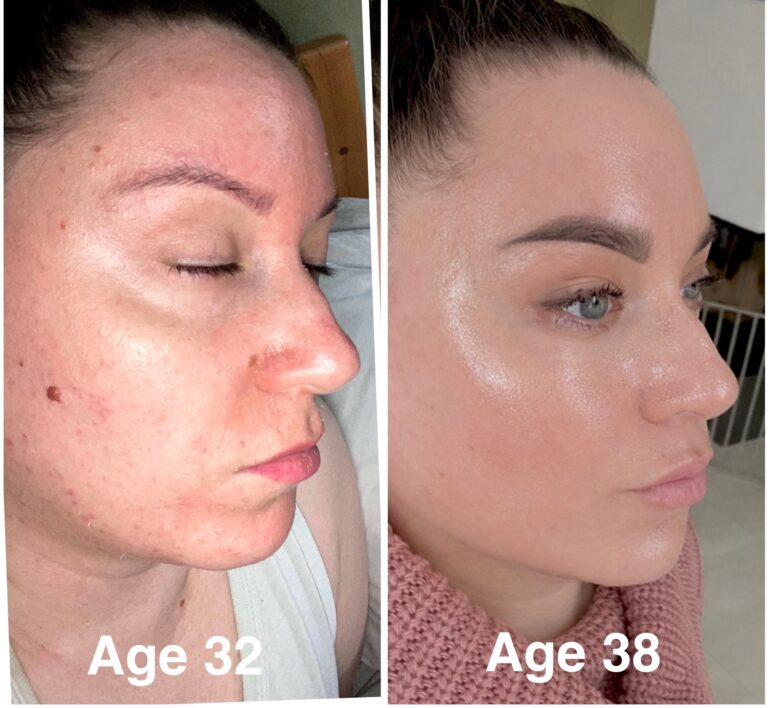
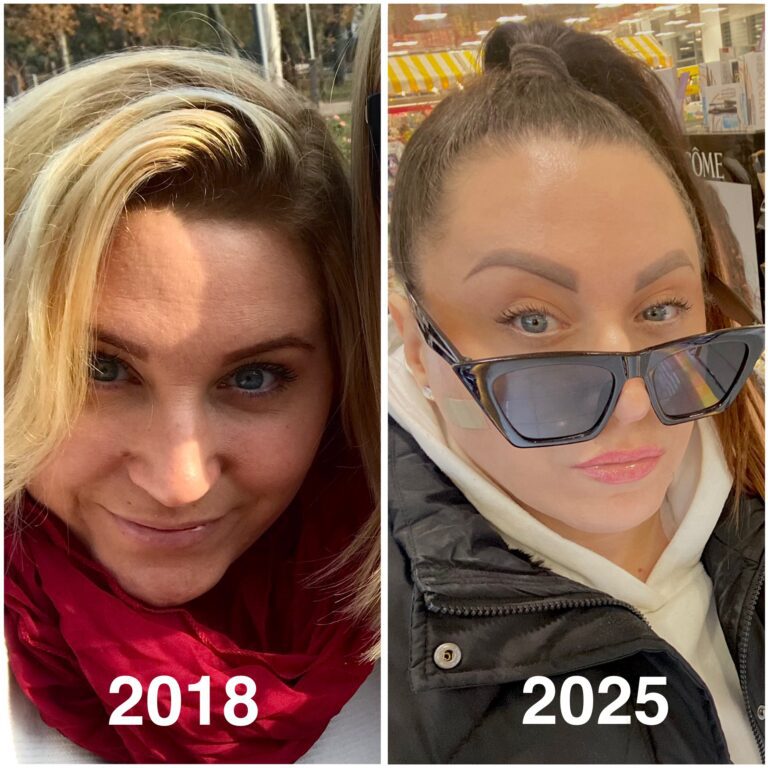
What Consistent Sunscreen Use Changed Over Time
Sunscreen results are usually subtle at first — which is exactly why many people underestimate how important daily SPF really is.
What does consistent sunscreen use actually do?
Sunscreen rarely creates dramatic overnight changes.
Instead, it helps prevent many of the issues people are trying to correct later — uneven tone, pigmentation, excess redness, and premature signs of aging.
That’s why the benefits often become most noticeable over months and years rather than days, but over months of consistent use, skin often becomes:
• More even skin tone — the patchy areas gradually settled
• Less redness fluctuation day to day
• Better, more lasting results
• Skin that felt more stable and less reactive overall
Sunscreen didn’t transform my skin overnight, it protected the progress I was already building.
Have you ever felt like sunscreen wasn’t doing anything?
I used to think that too.
The reality is that sunscreen often works quietly in the background. It’s protecting the progress your skincare routine is already creating rather than producing dramatic visible changes on its own.
Sunscreen Benefits
| Benefit | Daily SPF Helps? |
| Prevent sunburn | ✅ |
| Reduce pigmentation | ✅ |
| Protect collagen | ✅ |
| Support skin barrier | ✅ |
| Protect retinol results | ✅ |
| Reduce photoaging | ✅ |
Frequently Asked Questions
Do I need sunscreen if I stay indoors?
If you sit near windows or spend time in daylight even through glass, yes. UVA rays — the ones responsible for long-term skin aging and barrier damage — penetrate glass. A morning application of SPF on indoor days is a worthwhile habit, especially if you use retinol or other active ingredients. This isn’t theoretical — the Skin Cancer Foundation has documented real cases of significant UVA-related skin damage from decades of window-side sun exposure, including visible asymmetric aging in people who simply sat near a window or drove regularly.
What SPF level should I use daily?
SPF 30 is the minimum that dermatologists recommend for daily use. For everyday skincare — especially if you use retinol or other actives — SPF 50 provides a more meaningful margin of protection and is what I personally use. The difference in texture between SPF 30 and 50 has narrowed significantly with modern formulas. The American Academy of Dermatology specifically recommends choosing a sunscreen with an SPF of 30 or higher for daily protection.
Can I skip sunscreen on cloudy days?
No — up to 80% of UV rays reach the skin on overcast days. Cloud cover reduces UVB slightly but does very little to block UVA radiation. Daily application regardless of weather is what makes sunscreen actually work as a long-term skin protection habit. According to the Skin Cancer Foundation, UVA rays remain present at consistent strength year-round and can pass through both clouds and window glass, which is exactly why cloud cover offers far less protection than most people assume.
Why is sunscreen important every day?
Daily sunscreen helps protect against UV damage, pigmentation, collagen breakdown, and unnecessary stress on the skin barrier. Consistency matters more than occasional perfect use.
Can sunscreen help prevent premature skin aging?
Yes. Daily sunscreen is one of the most effective ways to help reduce UV-related collagen breakdown and visible signs of premature aging.
Why does my skin still tan when I wear sunscreen?
No sunscreen blocks 100% of UV radiation. Applying too little product, forgetting to reapply, or spending long periods outdoors can all reduce protection.
Is SPF in makeup enough?
Usually not. Most people don’t apply enough makeup to achieve the SPF level listed on the packaging. Dedicated sunscreen should still be used underneath.
Does sunscreen expire?
Yes. Most sunscreens remain effective for about three years unopened, but once expired they may no longer provide the SPF protection stated on the label. Always check the expiration date before use.
Should sunscreen be applied before or after moisturizer?
Sunscreen should be the final step of your morning skincare routine, applied after moisturizer and before makeup.
The simplest way to think about sunscreen
Daily sunscreen helps:
• protect collagen
• reduce pigmentation
• support the skin barrier
• protect retinol results
• reduce long-term UV damage
The best sunscreen routine is the one you can repeat consistently.
Sometimes one small change in your sunscreen routine can make a bigger difference than adding another skincare products.
Final Thought
Sunscreen is not an extra step, and it is not only for beach days or summer holidays.
The retinol, the barrier support, the calmer skin, the gentle consistent habits — all of it works better when your skin is protected during the day.
Skincare is not only about what you apply to your skin. It is also about what you protect consistently every day.
What has been the hardest part of wearing sunscreen consistently? Is it finding a formula you enjoy, remembering to reapply, or wearing SPF under makeup? Leave a comment below and tell me about your experience.
This article may contain affiliate links. I only share products I personally use or trust.