Gentle Cleansing Routine for Sensitive Reactive Skin
Have you ever wondered why your skin still feels irritated, congested, or uncomfortable even though you’re using good skincare products?
If your skin feels reactive, dull, congested, or constantly irritated, your cleansing routine may be affecting your skin more than you realize.
For years, I focused on serums and active ingredients, convinced the answer had to be another product. I didn’t realize the step affecting everything else was the one I barely thought about: cleansing.
Many sensitive skin routines focus heavily on serums and actives while overlooking the one step that affects everything else: cleansing. Even good products struggle to work properly when your skin barrier is constantly stressed.
What if your cleanser is the reason your expensive skincare never seems to deliver the results you hoped for?
A proper skincare routine does not start with the most expensive product you own. It starts with how effectively and gently you remove what is already on your face. When cleansing is too harsh — or not effective enough — your skin barrier spends the rest of the routine trying to recover.
This guide explains how to build a gentle face cleansing routine that supports sensitive skin, protects the barrier, and helps the rest of your skincare routine work more effectively.

What Is a Gentle Cleansing Routine in Simple Terms?
| Question | Quick Answer |
| What is gentle cleansing? | Removing dirt, SPF and oil without damaging the skin barrier. |
| Who needs it? | Anyone with sensitive, reactive or dehydrated skin. |
| Is double cleansing necessary? | Yes, if you wear sunscreen or makeup. |
| What matters most? | Gentle products and consistency. |
Why Your Cleansing Routine Affects Your Skin Barrier
Why does my skin still feel dirty after cleansing?
Many people assume cleansing should leave the skin feeling squeaky clean. In reality, healthy cleansing removes buildup without disrupting the barrier. If your skin feels greasy shortly after washing or tight immediately afterward, your cleansing routine may need adjusting.
Cleansing often feels like the simplest part of skincare — but it has a major impact on how your skin functions every day. What happens on your skin throughout the day is more complex than it looks from the outside.
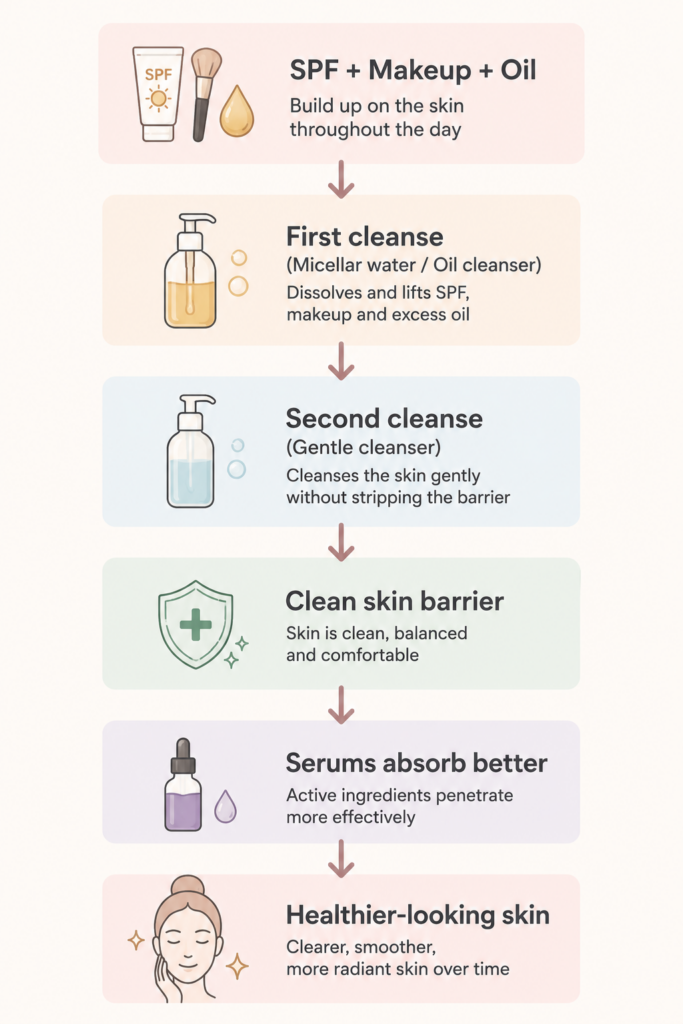
By the end of a normal day, your skin has accumulated:
• Sunscreen — which does not rinse off easily with just water
• Excess sebum and natural skin oils
• Sweat and environmental residue
• Pollution particles and airborne debris
• Bacteria that have settled on the skin surface throughout the day
If this layer is not properly removed, it creates a barrier that prevents everything you apply afterward from absorbing correctly. Your moisturizer sits on top instead of penetrating. Your serum cannot reach the skin cells it is meant to support. And your skin stays in a low-level state of congestion and irritation that you might not even recognize as a cleansing problem.
If your skin still feels slightly tight after an gentle cleanse, a hydrating toner may help restore comfort before serum and moisturizer.
Key Takeaway
Gentle cleansing is not about making your skin feel squeaky clean. It’s about removing sunscreen, oil and impurities while keeping your skin barrier comfortable enough for the rest of your routine to work.
Double Cleansing: What It Is and Why It Actually Works
If your skin feels congested, textured, or irritated despite using good products, incomplete cleansing may be part of the problem.
If you wear makeup or sunscreen — one cleansing step is not enough.

| Single cleanse | Double cleanse |
| Removes some dirt | Removes SPF, makeup and oil |
| May leave residue | Cleans more completely |
| Higher risk of congestion | Better product absorption |
| Suitable without SPF | Best for daily sunscreen users |
Is micellar water enough on its own?
Micellar water can help remove makeup, sunscreen, and surface buildup, but for many people it works best as the first step of an evening cleanse — not the only step.
If you wear sunscreen daily or your skin feels congested easily, following micellar water with a gentle water-based cleanser can give you a more complete cleanse without needing to scrub your skin.
• Second step: a gentle, water-based cleanser — this cleans the skin itself without stripping the barrier
Do I really need to double cleanse if I only wear sunscreen?
Yes, if you wear sunscreen daily, double cleansing can help remove it more effectively. Sunscreen is designed to stay on the skin and resist sweat, oil, and water, so a single gentle water-based cleanser may not remove it completely.
Daily sunscreen should be removed thoroughly every evening to help prevent buildup and support skin health. Skin Cancer Foundation
The first cleanse helps break down SPF, makeup, and sebum. The second cleanse gently cleans the skin itself, leaving your face clean without needing to scrub or use a harsh cleanser.
Sunscreen clings to the skin in a way that a single gentle rinse will not fully remove.
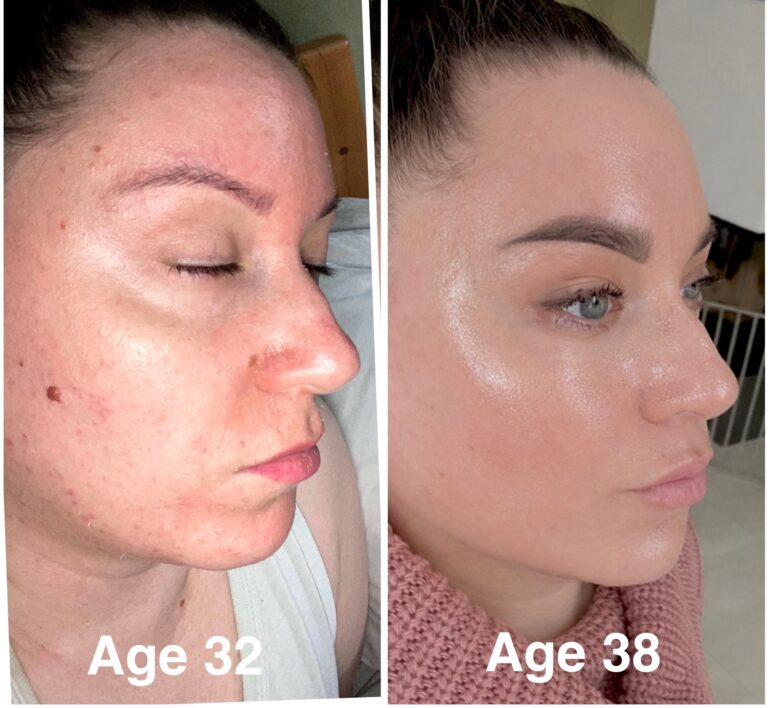
Adding a proper first cleanse in the evening can completely change how your skin responds to the rest of your routine. Products absorbed better. Breakouts reduced. My skin stopped feeling congested in the morning even after a full night of sleeping in what I thought was a clean face.
Can double cleansing cause irritation?
Double cleansing can cause irritation if the products are too harsh, if you rub the skin aggressively, or if both cleansing steps are stripping. But when done gently, double cleansing can actually support sensitive skin by removing sunscreen and buildup without relying on one strong cleanser.
For reactive skin, the key is to choose a gentle first cleanse and a barrier-friendly second cleanser. Your skin should feel clean, calm, and comfortable afterward — never tight, hot, or irritated.
This is the same foundation I built on when I slowly introduced retinol into my evening routine.
How to Choose a Gentle Cleanser for Sensitive Skin
Not all cleansers are equal, and the wrong one can undo everything else you are doing for your skin.
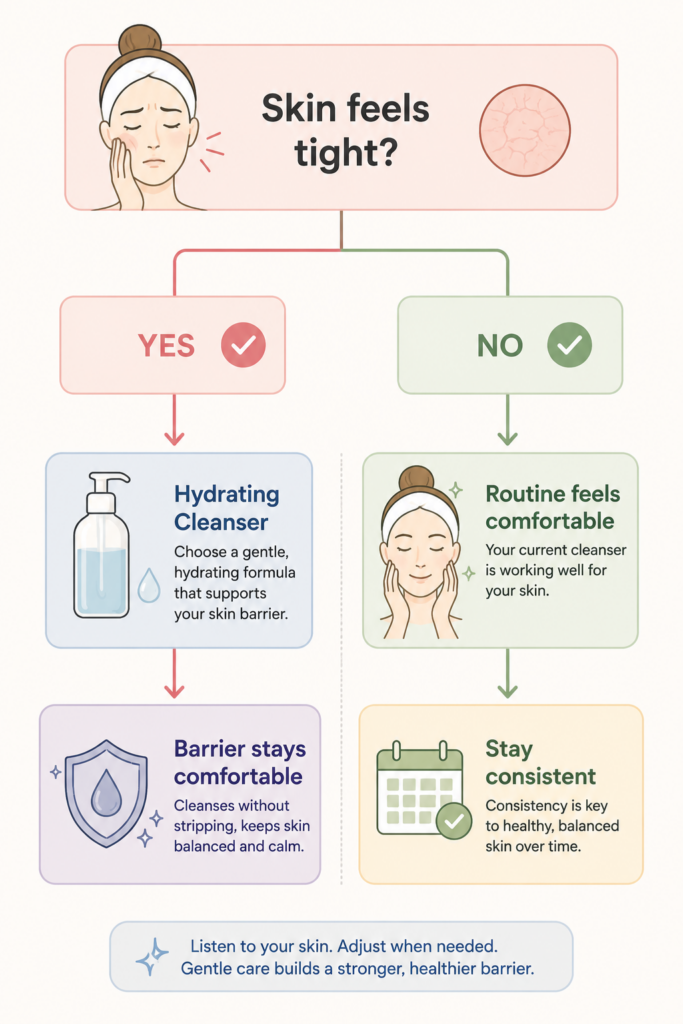
| If your skin feels… | Choose… |
| Tight after cleansing | Hydrating cleanser |
| Sensitive | Fragrance-free cleanser |
| Dry | Ceramide cleanser |
| Congested | Gentle double cleansing |
| Reactive | Low-foam cleanser |
Why does my skin feel tight after washing my face?
Tightness after cleansing is often a sign that your cleanser is disrupting your skin barrier. Your skin should feel clean, calm, and comfortable — not stripped, dry, or squeaky.
If your face feels tight within minutes of washing, your cleanser may be removing too much natural oil from the skin. For sensitive or reactive skin, this can make redness, dryness, and irritation worse over time.
For sensitive or reactive skin, look for these qualities in a cleanser:
• Hydrating formula — contains ingredients like glycerin or hyaluronic acid that support moisture retention
• Non-foaming or low-foam — high-lather cleansers are more likely to disrupt the skin’s pH
• No daily exfoliating acids — AHAs and BHAs in a daily cleanser are too much for most skin types
• Fragrance-free — synthetic fragrance is one of the most common causes of cleanser-related irritation
• pH-balanced — ideally between 4.5 and 6.5 to match the skin’s natural acid mantle
CeraVe Hydrating Cleanser is one example of a cleanser that supports sensitive skin without aggressive foaming or stripping. It contains ceramides that actively support the barrier rather than just cleaning the surface.
The goal of a cleanser is not to make your skin feel deeply clean. The goal is to remove what needs to be removed while leaving your barrier intact and comfortable. If your skin feels tight or dry after cleansing, your cleanser is too harsh.
What Often Makes Sensitive Skin Worse
Sensitive reactive skin often becomes calmer when you stop:
• using harsh, stripping cleansers
• over-cleansing multiple times a day
• relying on exfoliating cleansers daily
• trying to “deep clean” my skin
Over-cleansing is one of the most common and least-talked-about causes of sensitive, reactive skin.
Can cleansing too much damage your skin?
Yes. Cleansing too often can weaken the skin barrier, especially if you use harsh, foaming, or exfoliating cleansers. When the barrier is repeatedly stripped, skin may become more reactive, dry, oily, or irritated.
Over-cleansing can also create a frustrating cycle: your skin feels oily, so you cleanse more; then your barrier becomes stressed, so your skin produces more oil or feels even more uncomfortable. Sensitive skin usually needs balance, not more cleansing.
Skin doesn’t need to be aggressively cleaned. It needs balance.
Exfoliating Cleanser: When and How to Use Them Safely
Exfoliating cleansers can support smoother skin texture and help remove buildup — but only when used carefully.
Exfoliating cleansers are usually most effective when used only once or twice per week — especially for sensitive skin.
This helps with:
• removing dead skin cells
• improving skin texture
• supporting products absorption
• reducing buildup without overloading the skin
But this step needs balance.
Overusing exfoliating cleansers can damage the skin barrier, leading to:
• dryness
• irritation
• sensitivity
• inflammation
If you recognize any of those signs, stop exfoliating completely for two to three weeks and focus only on barrier repair. Then reintroduce exfoliation slowly — once a week maximum — and observe how your skin responds.
Dermatologists consistently recommend limiting exfoliation for sensitive skin to once or twice per week at most. More frequent use rarely produces better results and often produces the opposite.
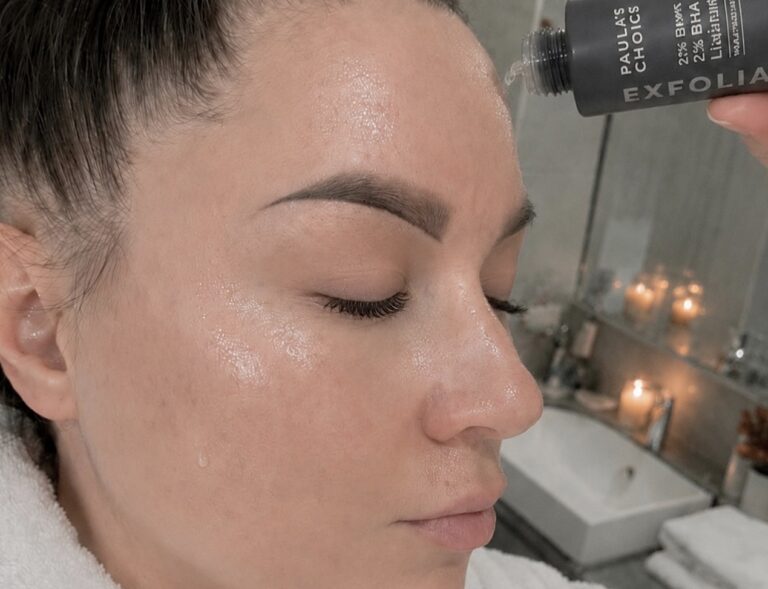
A gentle exfoliating cleanser can support smoother skin texture without overwhelming the barrier when used carefully.
This is the exfoliating cleanser I use in my routine →
Simple cleansing routine
Morning:
• gentle cleanser and 3 times per week: ice water face dip after cleansing
Ice water face dips may help reduce morning puffiness and temporarily calm the appearance of redness for some skin types → you can read more about it here
Evening:
• micellar water / oil cleanser
• gentle hydrating cleanser — or 1–2 times per week, an exfoliating cleanser
That is the complete routine. No third step. No hot water to ‘open pores.’ Just two targeted steps in the evening and one gentle step in the morning.
The simplicity is not laziness — it is intentional. Every unnecessary step is an opportunity for irritation, disruption, or barrier damage. The fewer steps your skin needs to tolerate, the more stable it becomes over time.

No overcomplication. No overload.
Frequently Asked Questions
How many times a day should you cleanser your face?
For most skin types, twice daily is the right frequency — once in the morning and once in the evening. If you exercise heavily and sweat significantly, a gentle rinse with water or a very mild cleanser after a workout is fine. But cleansing more than twice a day with a full cleanser disrupts the barrier and triggers excess oil production over time.
Is double cleansing necessary if you do not wear makeup?
Yes — if you wear sunscreen, which you should be doing daily. Sunscreen is formulated to stay on the skin and resist water and sweat, which means a single water-based cleanser often cannot fully remove it. An oil-based first cleanse or micellar water is the most effective way to break down SPF before your second cleanser.
Can over-cleansing damage your skin barrier?
Absolutely. Over-cleansing is one of the most common and least-recognized causes of a damaged skin barrier. Signs include persistent dryness, increased sensitivity, tightness after washing, more frequent breakouts, and products that suddenly sting when they previously did not. If you are experiencing these symptoms, reducing cleansing frequency and switching to a gentler cleanser is usually the first step toward recovery.
Why does my skin feel tight after washing my face?
Tightness after cleansing is usually a sign that your cleanser is too stripping. Your skin should feel clean, calm, and comfortable after washing — not dry, squeaky, or uncomfortable.
Do I really need to double cleanse if I only wear sunscreen?
Yes, if you wear sunscreen daily, double cleansing can help remove it more effectively. SPF is designed to stay on the skin, so using micellar water or an oil-based cleanser first can help break it down before your gentle second cleanse.
Is micellar water enough on its own?
Micellar water can remove makeup and sunscreen, but it usually works best as a first cleanse. Following with a gentle water-based cleanser helps remove leftover residue without needing to scrub.
Can double cleansing irritate sensitive skin?
It can if the products are too harsh or if you rub aggressively. But with gentle formulas and soft application, double cleansing can support sensitive skin by removing SPF and buildup without stripping the barrier.
What is the best cleanser for sensitive or reactive skin?
The best cleanser for sensitive skin is one that removes effectively without disrupting the barrier. Look for low-foam or non-foaming formulas, fragrance-free options, and ingredients that support hydration like glycerin or ceramides. CeraVe Hydrating Cleanser is what I personally use and recommend as a starting point — it is gentle, effective, and widely available.
Should you wash your face with hot or cold water?
Lukewarm water is usually the best choice. Very hot water can strip natural oils and increase dryness, while very cold water may not remove oil and sunscreen as effectively.
Can a cleanser damage the skin barrier?
Yes. Harsh cleansers, over-cleansing, and frequent exfoliation can weaken the skin barrier and increase dryness, redness, and sensitivity.
Do you need cleanser in the morning?
Most people benefit from a gentle morning cleanse, especially if they use skincare overnight or have oily skin. Very dry or sensitive skin may sometimes prefer rinsing with water only, depending on individual needs.
Should sensitive skin use foaming cleansers?
Low-foam or non-foaming cleansers are often better tolerated because they are less likely to leave the skin feeling stripped.
Quick Summary
| Remember | Why it matters |
| Gentle cleanser | Protects the barrier |
| Double cleanse | Removes SPF properly |
| Exfoliate 1-2— weekly | Prevents overloading the skin |
| Stay consistent | Supports healthier skin over time |
Final thought
Healthy skin doesn’t start with stronger products, more steps, or more aggressive treatments. It starts with a clean, calm, balanced foundation — and cleansing is that foundation.
If your cleanser is too harsh, your barrier is constantly trying to recover instead of functioning. If you are over-cleansing, your skin never gets the stability it needs to improve. If you are not removing sunscreen properly in the evening, every product you apply on top is working at a fraction of its potential.
Simplify the cleanse, and you stabilize the foundation. Everything else becomes easier from there.
Start simple. One gentle cleanser in the morning. A proper double cleanse in the evening. Exfoliation once or twice a week at most. Sensitive skin usually needs consistency and time before real improvement becomes visible.
| Time | What you may notice |
| Week 1 | Skin feels more comfortable |
| Week 2 | Less tightness after cleansing |
| Weeks 3-4 | Less redness and congestion |
| Weeks 4-6 | Healthier-looking, more balanced skin |
Give your skin at least four to six weeks before deciding whether a routine is working.
The consistent, gentle approach is almost always the right one. The same consistency has become the foundation of my entire skincare philosophy, which I explain in more detail in my Consistent Skincare Routine guide.
I’m curious: what part of cleansing has been the most confusing or frustrating for you?
Have you struggled to find a cleanser your skin actually tolerates? Are you wondering whether double cleansing is really necessary, or trying to figure out if you’re over-cleansing?
Leave a comment below and tell me where you’re feeling stuck. I read every comment and I’ll always do my best to help you find a gentler, more comfortable approach that works for your skin.
This article may contain affiliate links. I only share products I personally use or trust.