What Does a Toner Really Do for Your Skin? (And Why I Started Using One Again)
There was a time when I thought toner was completely unnecessary. Honestly? I thought it was one of those steps that skincare brands invented just to sell you another product. When I started rebuilding my routine around gentle skincare and skin barrier support,
If your skin feels tight after cleansing, switching to a hydrating toner may completely change how your skin feels after every wash. That was exactly my experience. If you’ve ever wondered what toner actually does, whether you really need one, or how to choose the right toner for your skin, this is everything I wish I had understood earlier:
| Question | Quick answer |
| What does toner do? | Helps hydrate, calm and prepare your skin after cleansing. |
| Do you need toner? | Not always, but it can greatly benefit dehydrated or sensitive skin. |
| Should toner sting? | No. A good toner should feel comfortable, not irritating. |
| When should you use toner? | After cleansing and before serum or moisturizer. |
| Who benefits most? | Sensitive, dehydrated and barrier-damaged skin. |
What Is a Toner in Skincare (Really)?
The word “toner” still carries a lot of outdated baggage. For a long time, it was associated with alcohol-soaked cotton pads, that sharp medicinal smell, and the feeling that your face had just been thoroughly sanitised. That version of toner exists — but it’s not what a modern hydrating toner is about.
In a gentle skincare routine, toner isn’t there to remove something from your skin. It’s there to restore balance after cleansing — to bring your skin back to a calm, receptive state before the rest of your routine follows.
If you’re unsure about the cleansing step itself, I wrote more about it here:
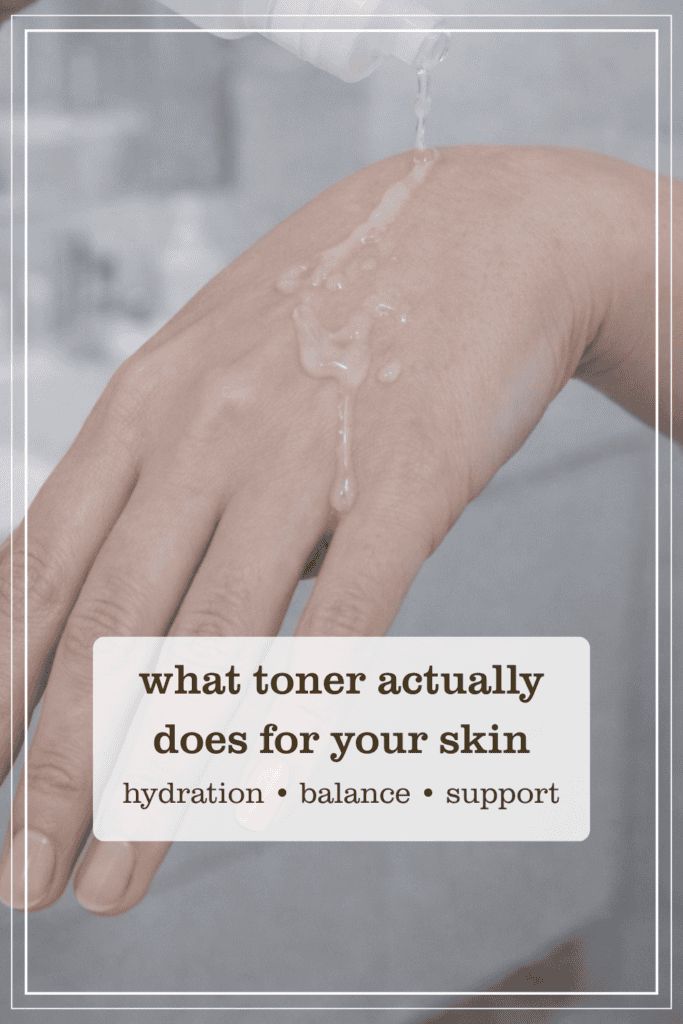
A well-formulated toner can:
∙ support and strengthen the skin barrier
∙ add an immediate layer of hydration
∙ calm redness and reduce the feeling of sensitivity
∙ help serums and moisturisers absorb more effectively
It’s not an extra step. It’s a connective step — the bridge between cleansing and caring.
If you want a more general explanation of what toner does and how to choose one, you can read more here.
How a Hydrating Toner Fits Into Your Routine
Before looking at specific ingredients, it helps to understand where toner fits into a gentle skincare routine. The simple flowchart below shows when a hydrating toner can support your skin barrier and when it may be optional.
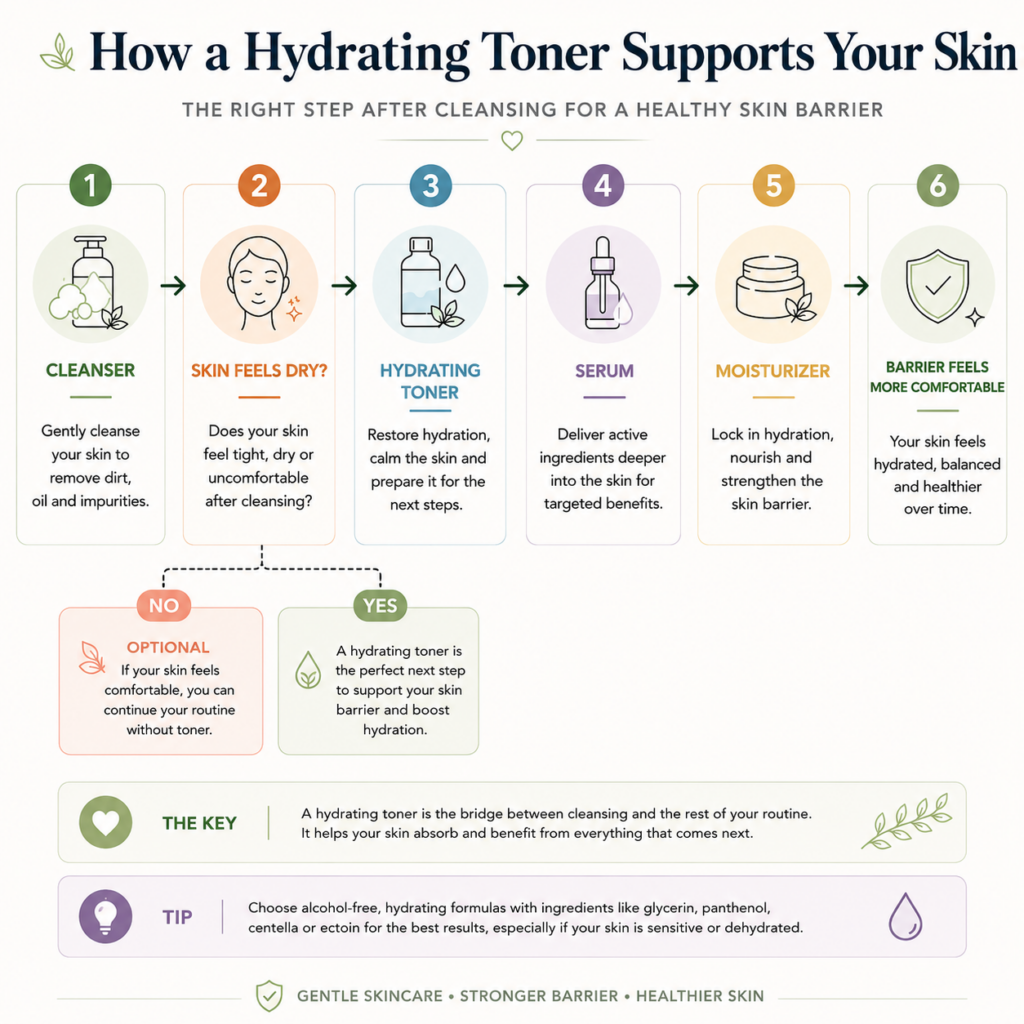
As the diagram shows, toner is not an essential step for everyone. However, if your skin regularly feels tight, dehydrated, or uncomfortable after cleansing, a hydrating toner can help restore moisture before applying serum and moisturizer. Supporting your skin barrier early in your routine often makes the following skincare steps feel more comfortable.
Key Takeaway
A hydrating toner is not about adding another skincare step. It’s about helping your skin feel calm, hydrated, and ready for everything that comes next.
Why I Changed My Mind About Toners
For years, I genuinely believed that toner wasn’t for me. My skin is on the sensitive side, and every toner I tried left me feeling worse, not better. I’d pat it on, wait, and feel my skin tighten almost immediately. I thought that was the point.
When I started paying closer attention to ingredient lists — and learning what was actually causing that tight, uncomfortable feeling — everything shifted. The culprits were almost always alcohol and strong astringents. Ingredients that were essentially pulling moisture out of my skin while making it feel temporarily “clean.”
The first time I tried a genuinely hydrating toner with a simple, skin-supportive formula, the experience was almost disarmingly quiet. No tingle, no tightness, no reaction. Just skin that felt settled. And I remember thinking: this is what it’s supposed to feel like.
What a Good Toner Should Actually Do for Your Skin
The simplest test: how does your skin feel 30 seconds after you apply it?
If it feels tight, uncomfortable, or slightly irritated — that’s not the toner working. That’s a signal that something in the formula is disrupting rather than supporting your skin barrier. A good toner for sensitive skin should do the opposite.
It should:
Support hydration — helping your skin hold onto moisture right after cleansing, when it’s most vulnerable to water loss
Calm the skin — reducing that post-cleanse sensitivity, especially if your skin tends to be reactive
Prepare for what comes next — creating the right surface for your serum and moisturiser to absorb properly
Strengthen the skin barrier — consistently, quietly, over time
If your current toner is doing the opposite of any of these things, it’s not the right one for you. If you are not sure whether the tightness is caused by dehydration or a damaged skin barrier, this guide can help you understand the difference before changing your routine.
Ingredients I Look For in a Hydrating Toner
I used to choose skincare based on what looked appealing or what was trending. Now I choose based on what I know my skin actually responds well to — and the ingredient list is where I start.
For a hydrating toner that supports skin barrier repair, these are the ingredients I look for:
- Glycerin — one of the most reliable humectants in skincare; it draws moisture into the skin and helps keep it there This matters especially for reactive skin: a study published in the Journal of the American Academy of Dermatology found that sensitive skin often has a measurably weaker barrier function, and that combining multiple humectants like glycerin produces both faster and longer-lasting hydration than relying on a single ingredient.
- Panthenol — soothing, repairing, and deeply compatible with sensitive skin; it supports the barrier while calming any irritation. This isn’t just anecdotal — a review of clinical and in vitro studies confirmed that topical dexpanthenol (the active form of panthenol) accelerates skin barrier restoration and speeds up surface healing after irritation or minor damage – MDPI/PubMed review.
- Aloe vera — a calming and refreshing ingredient that works especially well in toner for sensitive skin formulas
- Ectoin — a less talked-about ingredient that I’ve come to love; it actively protects and strengthens the skin barrier, particularly when skin is under stress
- Centella asiatica — one of my personal favourites for sensitive skin care; it reduces reactivity and supports healing. Centella asiatica’s reputation is well earned: a comprehensive review of its clinical applications found that its active compounds — asiaticoside and madecassoside — support collagen synthesis, reduce inflammation, and reinforce the skin barrier – Pharmaceutics/PMC review.
If you’re interested in ectoin specifically, I wrote more about it here: These ingredients work with the skin, not against it. They support what the skin is already trying to do — which is exactly what a toner should do too. If you want to explore a few hydrating toners with ingredients like glycerin, panthenol, centella or other barrier-supportive ingredients, these are the ones I personally rotate between and keep coming back to.
That kind of layered hydration can also support a glass skin routine without relying on aggressive exfoliation or overwhelming sensitive skin.
How to Choose the Right Toner for Your Skin
Choosing the right toner made a big difference for me.
| If your goal is… | Choose… |
| More hydration | A hydrating toner with glycerin |
| Support a weakened skin barrier | A barrier-support toner with ectoin or panthenol |
| Reduce visible redness | Panthenol + Centella asiatica |
| Dry or dehydrated skin | Glycerin + Ectoin |
| Sensitive or reactive skin | An alcohol-free soothing toner |
Not all toners are created for the same purpose. Some are designed to exfoliate, while others focus on hydration and calming the skin.
If your goal is gentle skincare and skin barrier support, it’s better to choose a toner that:
∙ is alcohol-free
∙ contains hydrating ingredients like glycerin
∙ includes soothing ingredients like panthenol or aloe
∙ supports the skin barrier, not weakens it
I stopped looking for strong toners and started choosing supportive ones — and that’s when my skin became more stable.
Do You Actually Need a Toner?
| Skin type | Toner recommended? |
| Dry | ✅ |
| Sensitive | ✅ |
| Barrier damage | ✅ Highly recommended |
| Oily | Depends |
| Normal | Optional |
Can Toners Be Drying? (Yes — But Only Certain Ones)
This is still worth addressing, because the concern is completely valid.
Some toners on the market still contain alcohol and strong astringents. And yes — those toners can absolutely dry out your skin, weaken your skin barrier, and increase sensitivity over time. Using them consistently is essentially undoing the work that the rest of your skincare routine is trying to accomplish. Research has measured it directly: ethanol-based ingredients increase transepidermal water loss by extracting lipids from the skin’s outer layer, which is exactly the mechanism behind that tight, stripped sensation – NUNKORO, citing dermatological research.
A well-formulated hydrating toner and an alcohol-based astringent toner are not the same product. They’re barely the same category.
What Should You Avoid in a Toner?
| Better choices | Ingredients to avoid |
| Glycerin | High alcohol |
| Panthenol | Witch hazel (high amounts) |
| Ectoin | Strong fragrance |
| Betaine | Menthol |
| Centella | Harsh astringents |
How Often Should You Use Toner?
One of the most common questions is how often toner should be used.
For me, using toner once or twice a day works best:
∙ in the morning — to refresh and hydrate
∙ in the evening — after cleansing, to restore balance
But more important than frequency is how your skin responds.
If your skin feels calm and hydrated, your toner is doing its job.
| Time | What you may notice |
| First use | Less tightness |
| Week 1 | Better hydration |
| Weeks 2–4 | Skin feels calmer |
| Weeks 4–8 | Better barrier comfort |
This gradual improvement is also why toner can fit well into a skin longevity routine: the goal is not an instant transformation, but consistent support that helps your skin remain comfortable and resilient over time.
Where Toner Fits in My Current Skincare Routine
My routine has become simpler over the years. I used to layer endlessly, convinced that more steps meant better results. Now I know that a few well-chosen products, used consistently, do far more than ten mediocre ones.
My current skincare routine looks like this:
- Gentle cleanser
- Toner ← this is where the shift happens
- Serum
- Moisturiser
The toner step is the moment my skin moves from “just cleaned” to “now being taken care of.” That transition matters more than I used to realise — especially on mornings when my skin wakes up reactive or on evenings when it’s been exposed to pollution or stress. It’s the step that makes everything that follows feel more intentional.
Who Should Use a Toner?
Toner isn’t essential for every person or every routine. But it can make a real difference if:
∙ your skin regularly feels tight after cleansing
∙ you have sensitive or reactive skin that struggles to settle
∙ you’re actively working on skin barrier repair
∙ you want a more hydrating skincare routine
∙ you feel like something is missing between cleansing and the rest of your steps
It won’t transform your skin overnight. But used consistently, with the right formula, it adds something that’s hard to articulate until you experience it — a steadiness. A baseline of calm that makes everything else work better.
Frequently Asked Questions
Can toner replace a serum?
No. A toner prepares your skin for the next steps, while serums deliver higher concentrations of active ingredients.
Should you use toner after every cleanse?
Most people benefit from using a hydrating toner after cleansing, especially if their skin feels tight or dehydrated.
Can toner help a damaged skin barrier?
A hydrating toner containing ingredients like glycerin, panthenol, ectoin or centella may support barrier recovery as part of a consistent skincare routine. In a randomized controlled trial involving 280 patients, twice-daily topical Centella asiatica measurably improved scar and skin recovery outcomes within eight weeks compared to a control group — supporting why it’s such a common ingredient in barrier-repair formulas, including toners.
Is toner necessary if you already use moisturizer?
Not always. However, toner can add hydration immediately after cleansing and help your moisturizer work more effectively.
Should toner make your skin feel tight?
No. A well-formulated toner should leave your skin feeling comfortable and hydrated rather than stripped.
Final Thoughts
I used to think adding a toner to my routine meant complicating it. Now I see it completely differently.
For me, it became the step that made my routine feel whole — the quiet, supportive layer between cleansing and caring. It didn’t fix everything overnight, and it didn’t need to. It just helped my skin feel more like itself, more consistently.
Have you already found a toner your skin loves, or are you still looking for one that feels comfortable?
I’d love to hear about your experience in the comments. If you’re unsure which type of toner might suit your skin, feel free to ask — I read every comment and I’m always happy to help whenever I can.
This article may contain affiliate links. I only share products I personally use or trust.