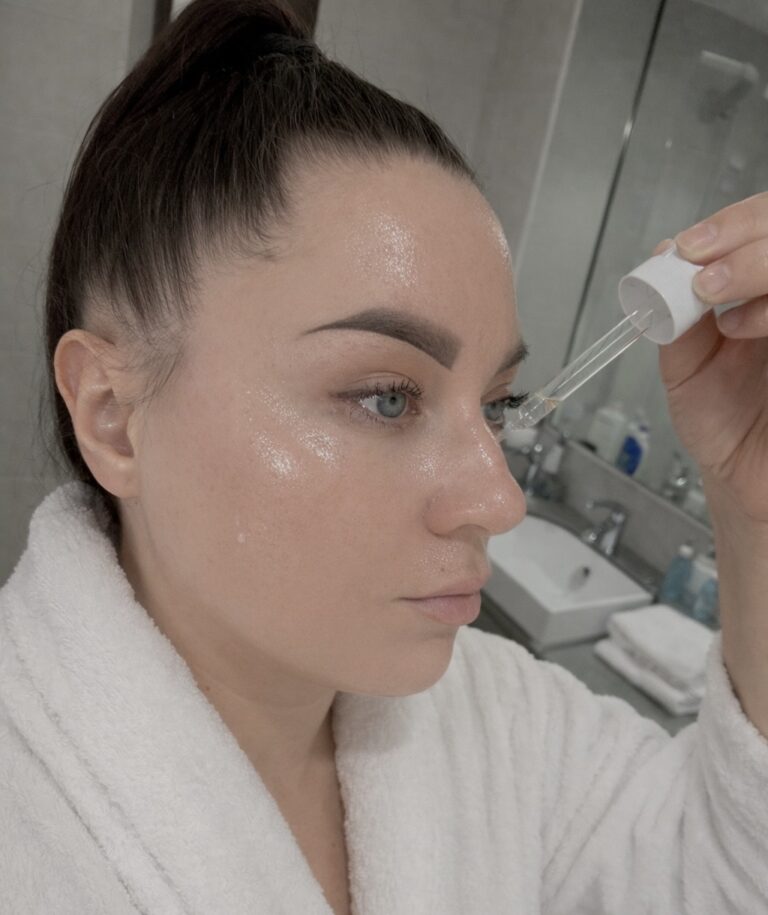
Ice Water Face Dip Benefits, Safety, and My Gentle Routine
Most skincare advice focuses on products, ingredients, and treatments — which makes it easy to overlook how much small daily habits can also affect your skin.
What surprised me most is that one of the simplest things I added to my mornings ended up making a visible difference in how calm, awake, and refreshed my skin looked.
Ice water therapy. Not the extreme social media version, just a short, gentle, repeatable routine that helps my skin feel less puffy, less dull, and more balanced in the mornings. And honestly, the fact that it costs nothing makes me love it even more.
What can ice water therapy actually do for your skin?
Ice water therapy is a short cold-water facial routine commonly used to temporarily reduce morning puffiness, calm visible redness, and refresh tired-looking skin.
| Ice water therapy may help | Ice water therapy will not do |
| Reduce temporary puffiness | Repair the skin barrier |
| Calm visible redness | Replace moisturizer |
| Wake up tired-looking skin | Permanently tighten pores |
| Refresh the complexion | Replace sunscreen |
| Support a calming routine | Create permanent structural changes |
How My Ice Water Face Routine Actually Looks
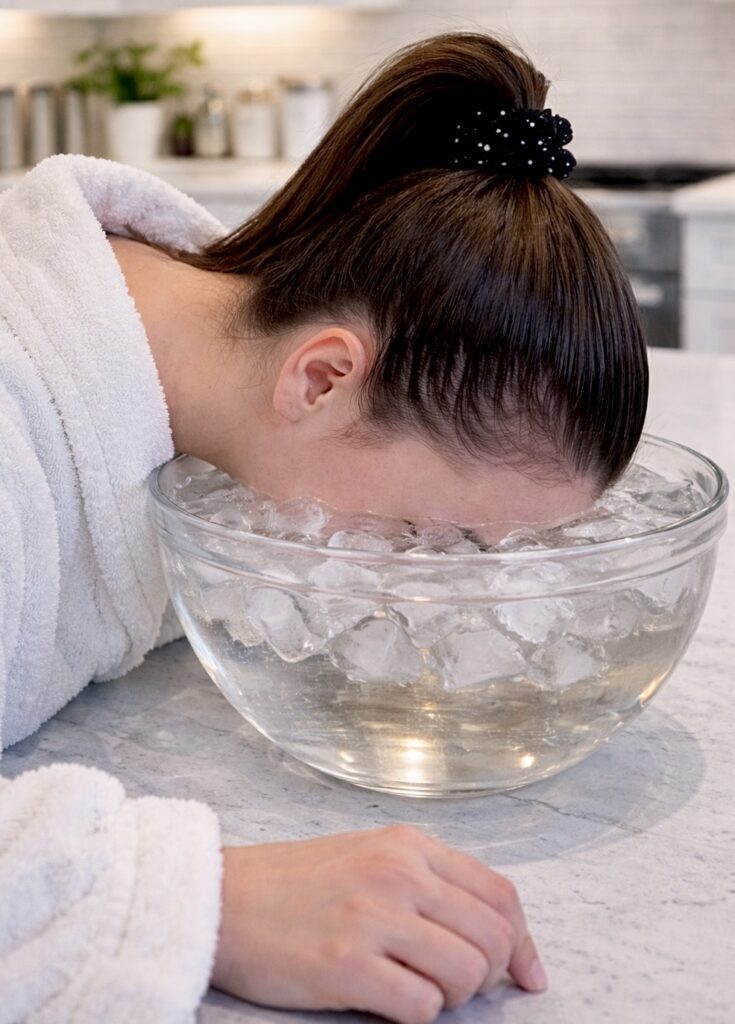
A lot of ice water routines online look intense, uncomfortable, or almost competitive — but that is not the approach that works best for my skin.
The version I use is intentionally simple and takes less than two minutes:
• Cool to cold water in a bowl — not ice-bath cold, just noticeably cool
• A few ice cubes added to bring the temperature down
• Three rounds of about ten seconds each — face submerged, eyes closed
That is the entire routine. No extreme cold exposure. No forcing discomfort. No dramatic “shock therapy.”
If your skin tends to become reactive easily, shorter and gentler exposure is usually much safer than trying to push through intense cold for longer periods.
What helped my skin most was keeping the routine calm, repeatable, and consistent — the same approach I follow with the rest of my skincare.
How to Know Whether Ice Water Therapy Is Right for Your Skin
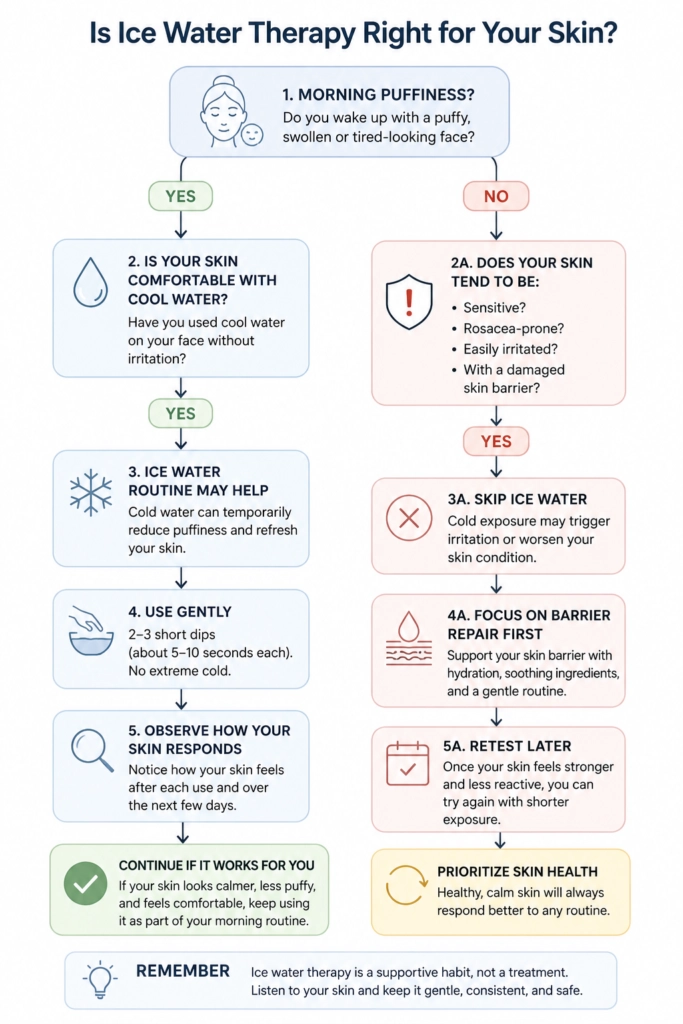
Not everyone benefits from cold exposure in the same way. Use the decision flowchart below to determine whether ice water therapy is likely to suit your skin or whether barrier support should come first.
What I Noticed After Using Ice Water Therapy Consistently
The results were subtle at first, but after a few weeks I started noticing clear differences between the mornings when I used ice water therapy and the mornings when I skipped it.
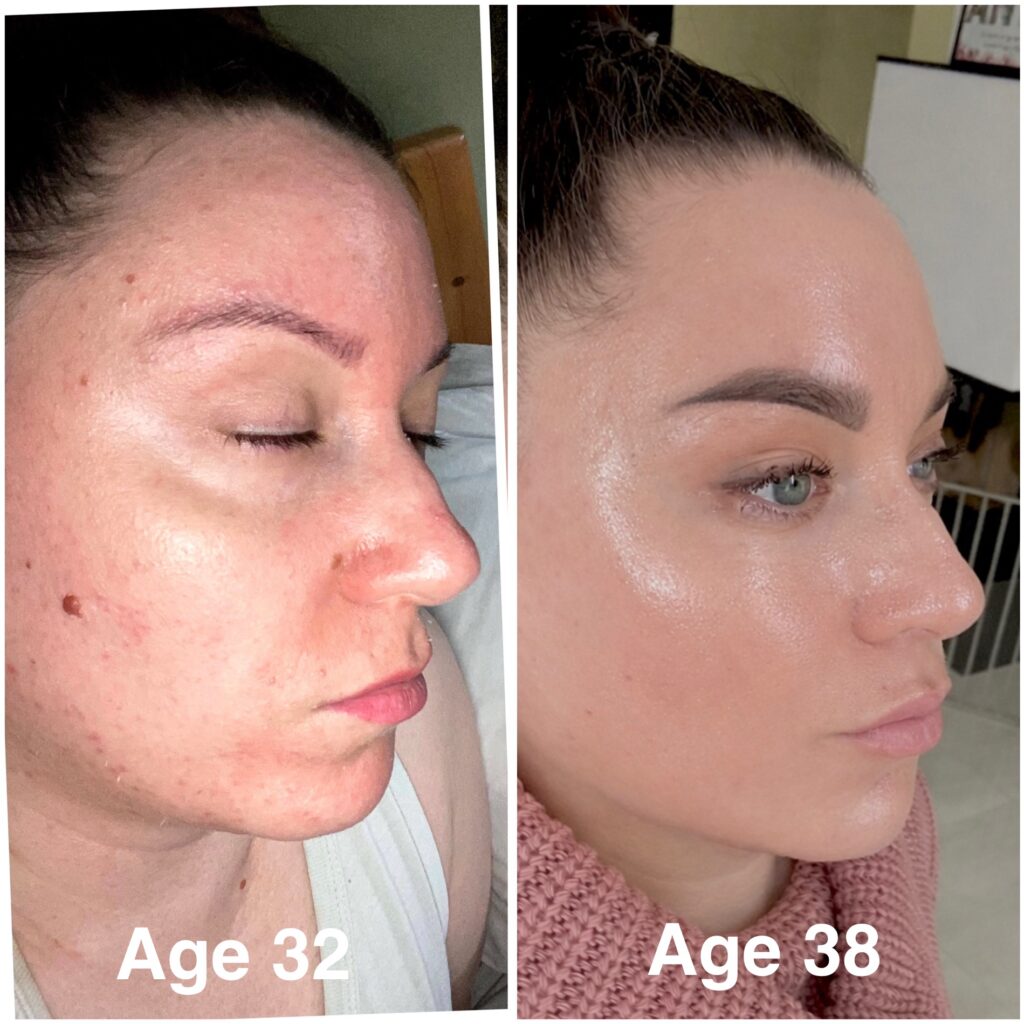
On the mornings I use my ice water routine consistently:
• my skin looks less puffy and more awake
• redness settles faster
• pores appear temporarily tighter around the nose and cheeks
• makeup applies more smoothly afterward
• my overall skin tone looks fresher and more even
If your skin also tends to look tired, swollen, dull, or puffy in the mornings, this is where ice water therapy may help the most noticeably.
However, persistent dullness or tightness is not always caused by puffiness alone. Sometimes dehydration or a damaged skin barrier can create similar-looking symptoms.
Not sure whether puffiness is the real problem?
If your skin feels tight, irritated, dehydrated, or sensitive in addition to morning puffiness, the underlying issue may be barrier damage rather than swelling alone. My Skin Barrier Quiz can help you identify the most likely cause before changing your routine.
Why Ice Water Therapy Can Help Puffy or Tired-Looking Skin
Ice water therapy works best when it becomes part of a simple, consistent skincare routine rather than replacing one. If you’re building a routine focused on long-term skin health, my guide on How a Consistent Skincare Routine Creates Natural Glow explains exactly why consistency matters more than intensity.
What does research say?
Research suggests that brief cold exposure may temporarily reduce puffiness and visible redness by causing superficial blood vessels to constrict. However, these effects are temporary and should be viewed as supportive rather than a replacement for consistent skincare or skin barrier care. Dermatologists generally recommend gentle cold exposure instead of extreme icing.
Further reading: American Academy of Dermatology – Everyday Skin Care
2 Tips for Maximizing Face Ice Bath Benefits
While submerging your face in ice water can provide many benefits for your skin, there are some ways to make ice face baths even more effective.
Here are three tips to help you get the most out of your face ice baths:
Add Beneficial Ingredients to Water
You can take your face ice bath to the next level by adding ingredients known for their skin-loving properties.
Here are some of the best ingredients to add to your face ice bath:
Rose Oil
Rose oil, for example, contains vitamins E, A, and C and omega and linolenic acids, which can help rebuild collagen. Studies show that rose oil has antibacterial, anti-inflammatory, and antioxidant properties that can help protect and heal the skin.
Aloe Vera
Aloe vera contains vitamins A, C, E, and B12, which can strengthen and protect the skin from UV damage. It has also been shown to stimulate collagen and elastin production, resulting in tighter skin.
Whole Milk
Lactic acid in whole milk acts as an anti-aging agent. Research shows that lactic acid can moisturize the skin and reduce pigmentation.
Cucumber
Cucumber soothes and hydrates the skin, which is why it’s commonly used in spa treatments. This January 206 study also shows that cucumber extract can have anti-inflammatory effects on the skin.
Combine with Warm Treatments
Alternating between warm and cold treatments can amplify the benefits of your face ice bath. Before submerging your face in the ice water, use a warm compress or steam your face for 5-10 minutes. The heat will open up your pores, allowing for deeper cleansing and debris removal. Follow up with an ice bath to tighten the pores, reduce inflammation, and promote a more even skin tone. This hot-and-cold combination can be particularly effective for acne-prone or congested skin.
Ice water therapy vs cold roller vs ice globes
| Method | Best for | Duration | Cost |
| Ice water | Whole face | 30 sec | Free |
| Ice roller | Local puffiness | 1-2 min | Low |
| Ice globes | Massage | 3 min | Medium |
Important Things I Avoid With Ice Water Therapy
If your skin is sensitive, rosacea-prone, or easily irritated, this part matters even more.
I never:
- hold my face underwater for long
- use freezing temperatures
- do it on irritated or damaged skin
- do it after strong actives or peeling
- do it more than once a day
Cold is helpful in small doses — not as shock therapy.
This is also why Iprefer introducing actives slowly – like when I started using retinol in my routine.
Who Should (and Shouldn’t) Try Ice Water Therapy?
Ice water therapy is not the right choice for everyone. While some skin types may benefit from gentle cold exposure, others may respond better by focusing on skin barrier repair first. The comparison below can help you decide which category best matches your skin.
| Who may benefit most from ice water therapy? | Ice water therapy may not be the best choice if |
| Morning puffiness | Active rosacea flare |
| Poor sleep | Broken or irritated skin |
| Temporary redness after heat | Eczema flare |
| Heat exposure | Cold urticaria (cold allergy) |
| Swollen eyes | Very sensitive or compromised skin barrier |
| Dull-looking morning skin | Current skin infection or open wounds |
| Office workers spending long hours indoors | Your dermatologist has advised against cold exposure |
| People with long screen time | You experience pain or prolonged redness after cold exposure |
Ultimately, your skin’s current condition matters more than following a trend. If your skin barrier feels healthy and you mainly struggle with temporary morning puffiness, ice water therapy may become a simple addition to your routine. However, if your skin feels irritated, stings easily, or reacts to many products, focusing on barrier repair first is usually the better long-term approach.
How Often Ice Water Therapy Works Best for Me
For my skin, every second morning works best.
It gives me the visible benefits without making my skin feel overstimulated or stressed, and if your skin is sensitive or reactive, starting slower is usually the better approach.
This is something I have learned repeatedly with skincare: consistency almost always works better than intensity.
The Unexpected Benefit I Noticed Most
The visible skin benefits are real for me — but the biggest difference ended up being something I did not expect at all.
That one quiet minute in the morning genuinely slows me down.
There is something about dipping your face in cold water that requires presence. You cannot be scrolling, rushing, or half-thinking about something else. It pulls you fully into the moment — just the cold, the breath, the quiet. And I have found that starting the day with that small moment of presence changes how I approach everything that follows.
It turns a skincare step into a moment of calm rather than correction.
If your skin responds better to calming, low-stress routines instead of aggressive treatments, ice water therapy can fit surprisingly well into a gentle skincare rhythm.
And when it comes to calming ingredients, ectoin is still one of my favorite options for supporting stressed or reactive skin.
Unlike the temporary effects of cold exposure, ectoin helps support hydration and skin resilience throughout the day, making it a useful addition to a barrier-focused routine.
Frequently Asked Questions
Does ice water therapy help reduce morning puffiness?
Yes. Ice water therapy is commonly used to temporarily reduce morning puffiness by causing blood vessels to constrict for a short period, making the face look fresher and less swollen.
How long should you keep your face in ice water?
Most people only need short exposure. Around 5–10 seconds per dip, repeated two or three times, is usually enough to refresh the skin without creating unnecessary stress. Longer sessions are not necessarily more effective and may increase irritation for sensitive skin.
What temperature should ice water be?
The water should feel cool to cold, but it does not need to be freezing. A bowl of cool water with a few ice cubes is usually enough to provide the temporary refreshing effect without exposing the skin to extreme cold.
Can ice water therapy reduce facial redness?
Ice water may temporarily reduce visible redness by constricting blood vessels for a short time. However, it does not treat the underlying cause of persistent redness, rosacea, or skin inflammation, so it works best as a supportive habit rather than a treatment.
Should you use ice water therapy before or after skincare?
Most people use ice water therapy before applying skincare products. After gently drying the skin, you can continue with hydrating serums, moisturizer, and sunscreen in the morning. This allows your skincare products to absorb normally after the cold exposure.
Can you do ice water therapy every morning?
Many people tolerate daily use well, but it is not necessary for everyone. If your skin is sensitive or reactive, starting every other morning and observing how your skin responds is usually the safer approach.
Does ice water therapy help your skin barrier?
Ice water itself does not repair the skin barrier. However, gentle cold exposure may support a calming skincare routine by reducing temporary puffiness and visible redness. If your barrier is already damaged, focusing on hydration and barrier-support ingredients should come first.
Does ice water actually tighten pores permanently?
No — and any claim that it does is misleading. Cold water temporarily constricts the skin tissue around pores, making them appear smaller in the short term. But pore size is largely determined by genetics, skin type, and sebum production. What consistent cold water exposure can do is reduce the chronic puffiness and inflammation that makes pores look larger than they are — and over time, that regular reduction adds up to a visibly more even skin surface.
Can I use ice directly on my skin instead of ice water?
I would not recommend applying ice cubes directly to bare skin. The temperature of direct ice contact can be too intense for the skin surface, and prolonged contact can cause irritation or even minor skin damage. Ice water in a bowl gives you the cold exposure with much more control over temperature and duration — which is what makes it safe and repeatable.
Is ice water therapy suitable for sensitive or rosacea-prone skin?
It depends on the individual, but caution is warranted. Cold exposure can trigger flushing in rosacea-prone skin rather than calming it. If you have sensitive or reactive skin, I would suggest starting with cool rather than cold water and keeping the exposure very brief — five seconds rather than ten — to see how your skin responds before building up. And if your skin is in an active flare, skip it entirely until things settle.
How long do the effects of an ice water face dip last?
The visible effects are usually temporary. Reduced puffiness and a fresher appearance may last for several hours, but the exact duration depends on your skin, the cause of the puffiness, and your daily routine. Ice water face dips work best as a temporary de-puffing habit rather than a permanent skin treatment.
Can ice water help acne or breakouts?
Ice water may temporarily calm the appearance of redness or swelling around some breakouts, but it does not treat the underlying causes of acne. It should not replace evidence-based acne treatments or professional dermatological advice.
Research-backed tip
Dermatologists generally recommend avoiding direct ice contact on sensitive or damaged skin. Gentle cold exposure may temporarily reduce puffiness, but extreme cold can increase irritation in some skin types.
Learn more: Cleveland Clinic – Facial Icing: Is Ice Good for Your Face?
Final Thoughts
Ice water therapy is not a miracle treatment — and it is definitely not a replacement for a good skincare routine, barrier support, or daily SPF.
Should you try ice water therapy?
| If your goal is … | Ice water therapy may be worth trying |
| Morning puffiness | ✅ |
| Temporary redness | ✅ |
| Better morning glow | ✅ |
| Healthy skin barrier | Only as support |
| Permanent pore reduction | ❌ |
| Wrinkle removal | ❌ |
For me, the biggest difference was never dramatic transformation. It was the way this small routine helped my skin look calmer, fresher, and more awake without adding stress or complexity, and honestly, I think that is why I still keep coming back to it.
Have you already tried ice water therapy, or are you still deciding whether it’s worth adding to your routine?
I’d love to hear about your experience, your skin concerns, or any questions you have about ice water therapy. Leave a comment below — I read every comment and do my best to reply whenever I can.
This is also one of the core ideas behind skin longevity. Small habits repeated consistently often support healthier-looking skin better than constantly chasing dramatic results. If you’d like to learn more, read my Skin Longevity Guide.